





Kitchenware Supplier for Retail Buyers: Building Product Lines That Sell, Ship, and Last
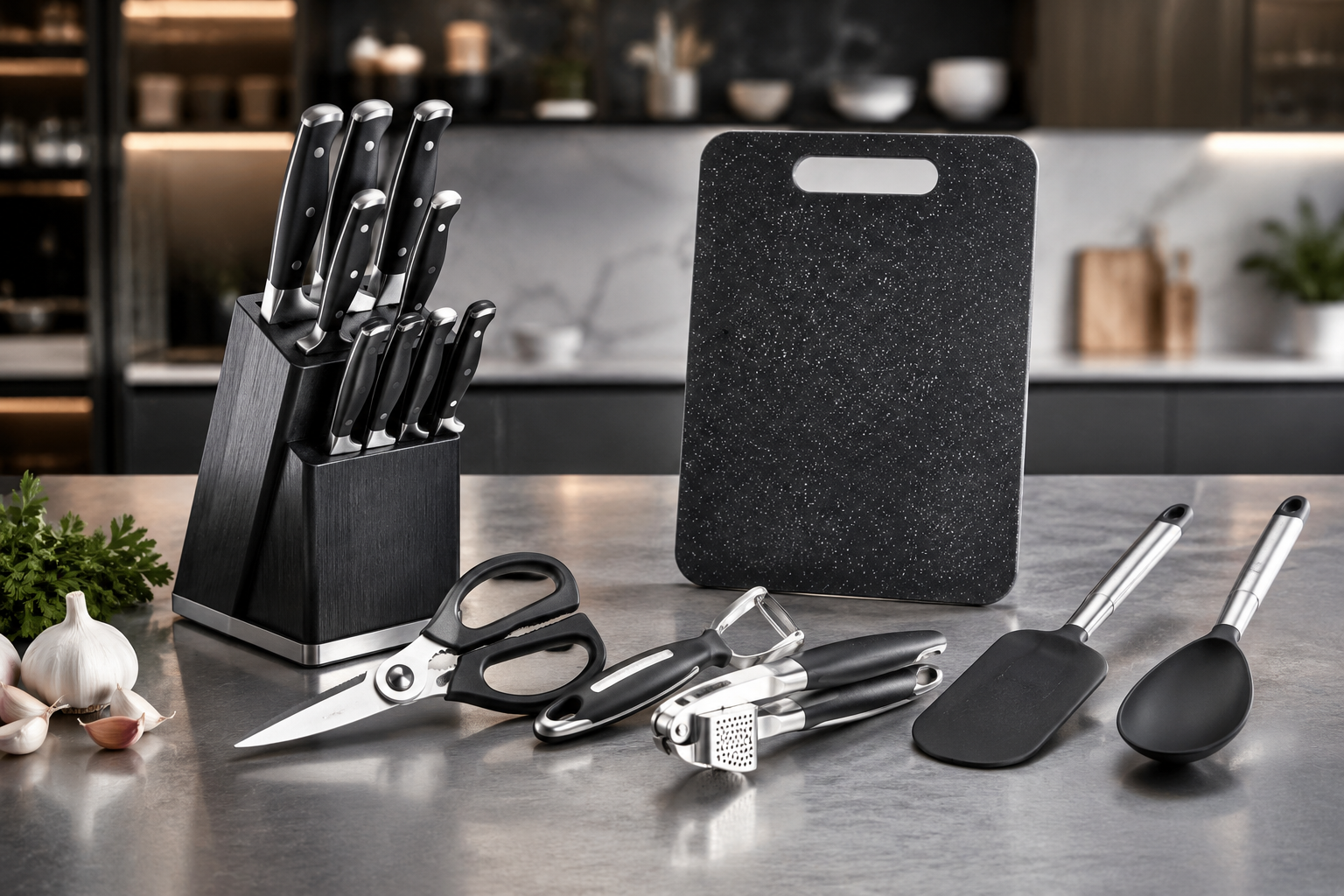
For many importers, choosing a kitchenware supplier begins with a catalog and a price list. But the real test comes later: Will the scissors still cut cleanly after repeated use? Will the knife handles feel stable? Will silicone tools feel safe for non-stick cookware? Will the packaging survive long-distance shipping and still look good on a retail shelf? These questions decide whether a product becomes a repeat order or a complaint file. BONET HOUSEWARE CO.,LTD focuses on kitchenware and precision cutting tools, with product directions covering kitchen scissors, knives, utensils, chopping boards, and multi-functional kitchen tools. Its website positions the company in Yangjiang, a well-known knife and scissors manufacturing base in China.
Material Logic Comes Before Product Selection
A serious kitchenware sourcing project should not start with color or packaging. It should start with material behavior.
For cutting tools, stainless steel affects corrosion resistance, edge retention, cleaning performance, and visual finish. For handles, PP, TPR, ABS, and soft-touch materials influence grip comfort, slip resistance, and durability. For silicone utensils, buyers need to check flexibility, odor control, heat resistance, surface smoothness, and cookware compatibility.
Kitchenware is not only decorative. Many products touch food, cookware, or food-preparation surfaces. The U.S. FDA notes that food-contact substances may include cookware, food-preparation surfaces, packaging components, and processing equipment, which makes material selection a direct sourcing concern, not just a product-design preference.
For retail buyers, the practical question is simple: does the material match the use case? A budget kitchen scissors line may need stable stainless steel blades and durable plastic handles. A premium kitchen knife set may need better blade finishing, stronger handle balance, and gift-ready packaging. A silicone spatula line should protect non-stick cookware while staying firm enough for daily cooking.
What a Kitchenware Supplier Must Control Before Bulk Orders
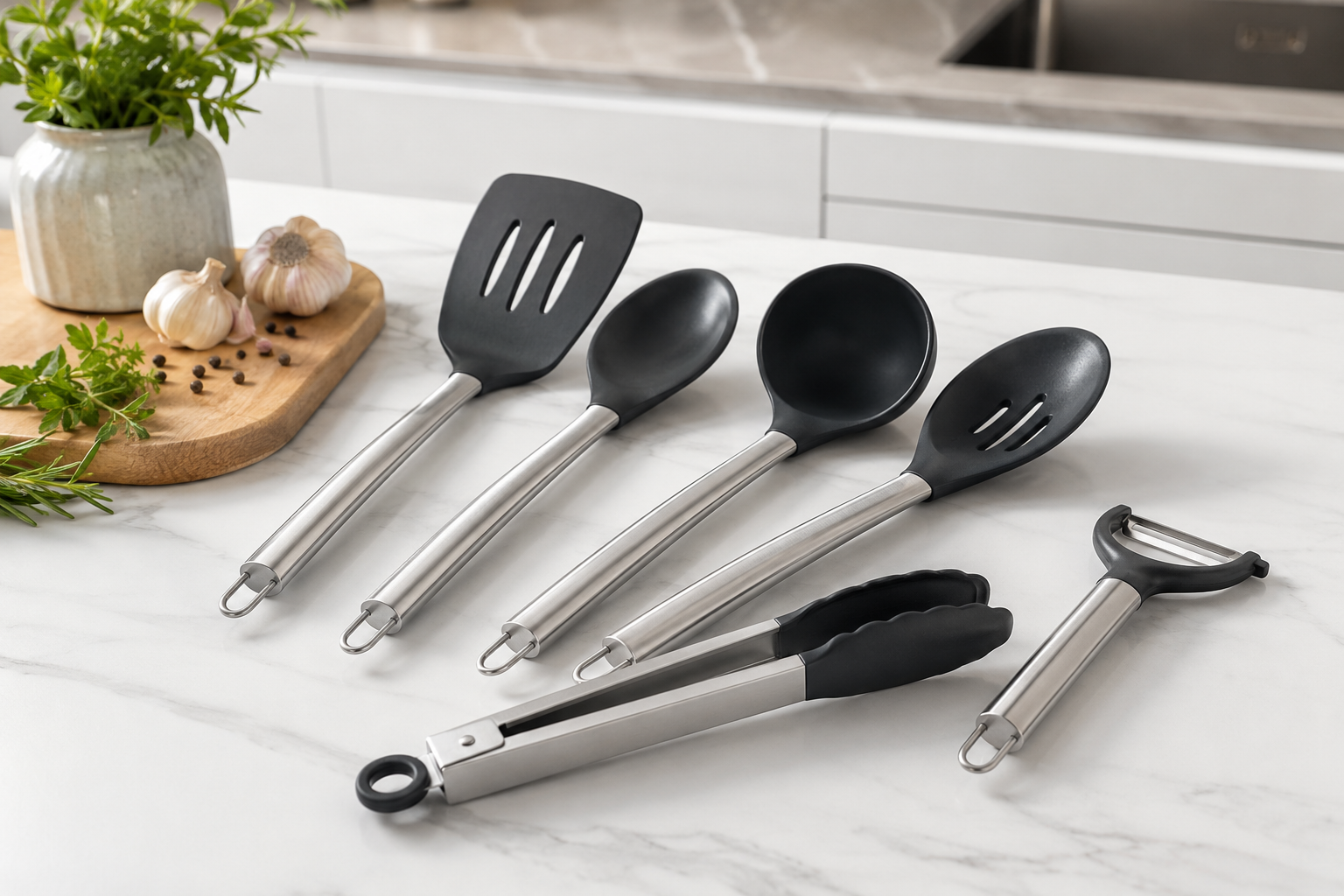
A reliable kitchenware supplier should help buyers reduce risk before mass production, not after defects appear. Product quality depends on several linked steps: material selection, stamping or forming, heat treatment, grinding, polishing, injection molding, assembly, inspection, cleaning, and packaging.
BONET’s public product and manufacturing direction emphasizes kitchenware, scissors, tools, and production-related capability, including precision cutting tools and kitchen product development. For a buyer, this matters because kitchenware defects are often process-related. A blade can look fine but lose cutting performance if heat treatment is unstable. A handle can look clean but feel weak if molding control is poor. A utensil can look attractive but fail retail expectations if packaging does not explain the function clearly.
| Buyer Concern | Weak Supply Approach | Better Supplier Approach |
|---|---|---|
| Product quality | Only checks finished samples | Controls material, process, assembly, and packing |
| Retail value | Sells random SKUs | Builds structured product lines by use case |
| Packaging | Added at the end | Designed for safety, display, and shipping |
| Bulk order risk | Solves problems after shipment | Confirms samples, inspection points, and carton protection early |
| Long-term cooperation | Focuses only on unit price | Supports repeatable quality and category planning |
Product Line Strategy: Do Not Buy Random Tools
Retail-ready kitchenware is easier to sell when products are planned as a line. A buyer may build one program around “daily food prep,” another around “compact kitchen tools,” and another around “outdoor cooking and BBQ.”
A basic kitchenware line can include:
- Kitchen scissors for cutting herbs, meat, food packaging, and light household tasks
- Knife sets for slicing, chopping, peeling, and daily meal preparation
- Silicone utensils for non-stick cookware and everyday cooking
- Chopping boards for food preparation and product bundling
- Peelers, garlic presses, graters, and food holders for small-tool retail turnover
This structure helps sales teams explain value faster. A supermarket shelf cannot rely on long technical descriptions. An Amazon listing cannot depend only on low price. The product must show its function quickly: cut, peel, stir, serve, protect cookware, save space, or improve preparation speed.
Parameters Buyers Should Review Before Confirming Samples
Before placing a bulk order, importers should prepare a technical checklist. It does not need to be overly complicated, but it must be specific enough to avoid vague sample approval.
| Product Type | Key Parameter | What Buyers Should Check |
|---|---|---|
| Kitchen scissors | Blade alignment and pivot stability | Smooth open-close action, no blade rubbing, clean cutting feel |
| Kitchen knives | Blade finish and handle balance | Even edge, stable handle, comfortable grip, no visible burrs |
| Silicone utensils | Flexibility and surface finish | No strong odor, smooth edge, suitable firmness, easy cleaning |
| Chopping boards | Surface flatness and edge finishing | No warping, smooth corners, stable cutting surface |
| Packaged tools | Drop and carton protection | Product does not shift, scratch, bend, or damage packaging |
This table is useful because it turns “quality” into visible checkpoints. Buyers can use it during sample review, supplier communication, pre-shipment inspection, and future product development.
Experience Matters When Retail Buyers Need Repeat Orders
A good supplier does not only deliver the first order. It helps buyers improve the second and third order.
If a kitchen scissors SKU sells well but customer reviews mention difficult cleaning, the next version may need a detachable design. If a knife set looks premium but shipping damage is high, the packaging structure needs adjustment. If silicone tools attract attention but repeat purchase is low, the product mix may need a better balance between spatula, spoon, ladle, and tongs.
ISO states that ISO 9001 is a globally recognized quality management standard that helps organizations improve performance, meet customer expectations, and demonstrate commitment to quality. For kitchenware buyers, the lesson is practical: repeatable processes matter. A supplier’s value is not only “we can make this product,” but “we can keep making this product consistently.”
A Practical Case: Building a Retail Kitchen Tool Program
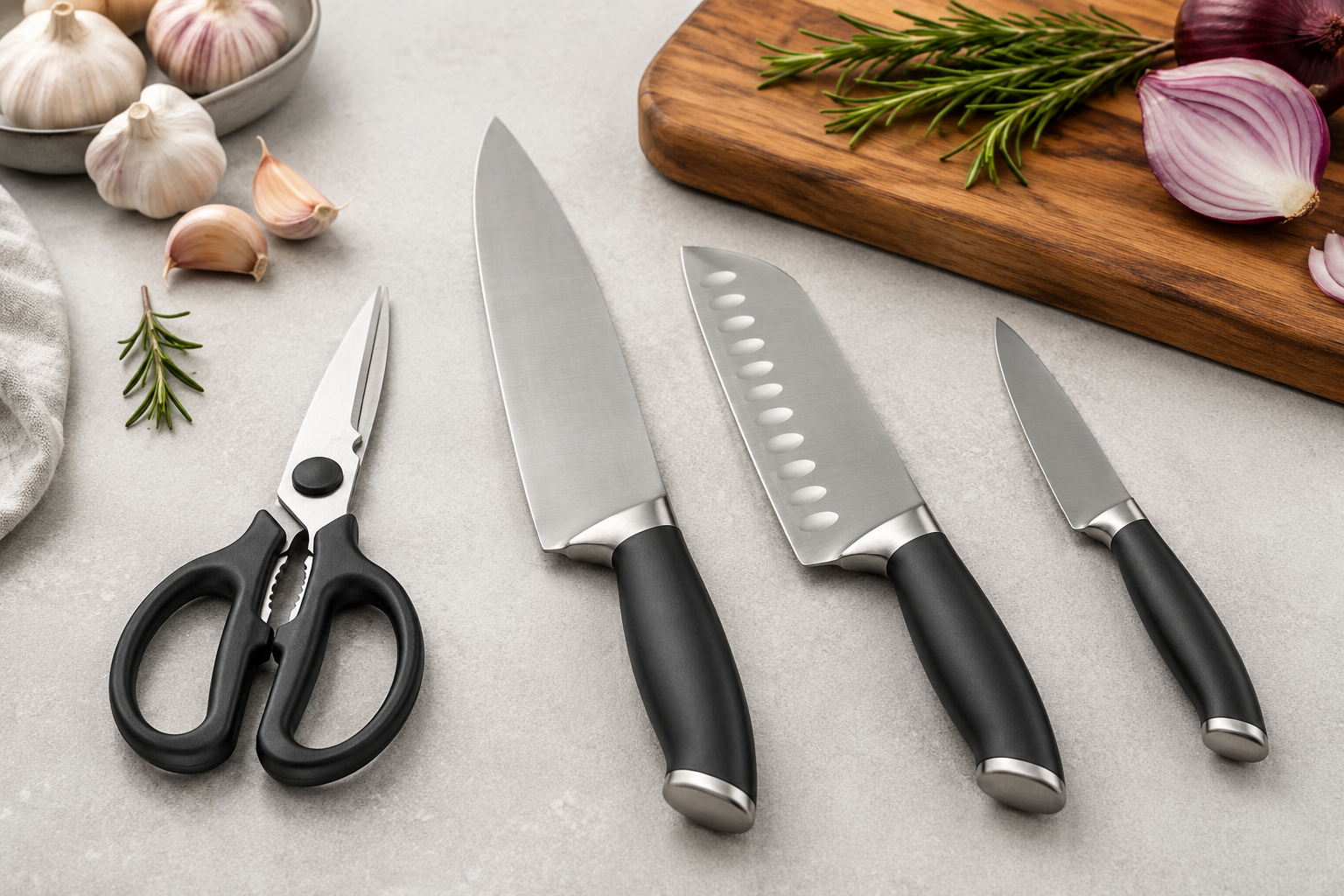
Consider a homeware importer preparing a new product line for supermarkets and online retail. The buyer wants kitchen scissors, a knife set, silicone utensils, and several compact kitchen gadgets. The risk is not product availability; many factories can provide similar items. The risk is whether the line feels coordinated.
A practical sourcing plan would divide the program into three price levels. Entry-level products focus on daily use and simple packaging. Mid-level products add better handles, stronger visual design, and multi-functional details. Premium SKUs use gift-ready packaging, better surface finish, and stronger product storytelling.
For example, kitchen scissors can be separated into standard household scissors, detachable cooking shears, and multi-purpose shears with opener or nutcracker function. Knife sets can be grouped by family kitchens, gift channels, or professional prep. Silicone utensils can be matched with non-stick cookware campaigns. This is where a capable kitchenware supplier becomes useful: not just selling items, but helping buyers shape a line that makes commercial sense.
Responsible Sourcing Is Becoming Part of Supplier Evaluation
Retailers and brand owners increasingly ask suppliers about transparency, documentation, and responsible sourcing. Sedex describes responsible sourcing as procurement that considers ethical, environmental, and social impact across operations and supply chains. amfori BSCI also promotes responsible business conduct and supply chain due diligence through its Code of Conduct framework.
For kitchenware importers, this means supplier evaluation should include more than product samples. Buyers should ask about material traceability, production workflow, inspection records, packaging standards, communication speed, and audit readiness. These details may not look exciting in a product photo, but they protect the buyer when a retailer asks hard questions.
Application Scenarios for Different Buyer Groups
A kitchenware program should be matched to the channel.
For supermarkets, products need simple selling points, safe packaging, visible functions, and stable price bands. For Amazon and online sellers, products need strong image value, clear feature language, and compact shipping volume. For distributors, product breadth and reorder stability are important. For private-label brands, color, handle design, packaging, logo, and product combination matter more. For promotional gift buyers, kitchen tools must be practical, lightweight, and easy to customize.
This is why one product rarely serves every buyer perfectly. The supplier should understand whether the customer is building shelf turnover, online conversion, brand identity, or wholesale margin.
FAQ
Q1: What makes a kitchenware supplier suitable for B2B buyers?
A suitable supplier should offer stable product categories, material control, sample support, quality inspection, packaging options, and clear communication for bulk orders.
Q2: Which kitchenware products are easier to build into a retail line?
Kitchen scissors, knife sets, silicone utensils, chopping boards, peelers, garlic presses, and compact multi-functional tools are practical because they solve daily kitchen tasks and are easy to explain to buyers.
Q3: What should importers check before placing a kitchenware order?
Importers should check materials, edge finish, handle comfort, assembly quality, packaging strength, product function, compliance support, and whether the supplier can maintain consistent quality across repeat orders.
Choosing a Supplier That Supports Long-Term Retail Growth
The right kitchenware supplier helps buyers build products that are not only attractive in photos, but also stable in production, clear in function, practical in use, and ready for retail channels. BONET’s product direction covers kitchen scissors, knives, utensils, chopping boards, and multi-functional kitchen tools, making it suitable for importers, distributors, supermarkets, online sellers, and private-label buyers looking to build a structured kitchenware line. Explore the company’s product range through the BONET kitchenware homepage.
For buyers who care about supplier background, product philosophy, and long-term sourcing cooperation, factory positioning and category experience are worth reviewing before sample approval. You can learn more through the BONET About Us page.